
Lord Howe Island is a heavenly subtropical destination that has the southernmost coral reefs in the world and a spectacular array of unique marine life. However, it is also one of the most expensive dive destinations in Australia – so is it worth the effort and expense to visit? Author and photographer Nigel Marsh thinks so…
Lord Howe Island is located 800km northeast of Sydney and was declared a World Heritage Site in 1982. It is a place I have wanted to dive for over 40 years. However, each time I looked at booking a trip the price was so expensive that I always ended up going somewhere else. Well in March this year I decided to ignore the expense and finally booked a week of diving on the island.

Now before you can book flights to Lord Howe, you need to have accommodation locked in, as visitor numbers are limited to 400 at a time. For our week Diveplanit booked a week at Leanda Lei Apartments and a ten-dive package with Dive Lord Howe. This was pricey enough, then came the flights, almost $2000 for a 90-minute return flight from either Sydney, Newcastle, Port Macquarie or the Gold Coast. Not only that, it was a light plane, with no toilet, no cabin service and with 14kg maximum check-in luggage! I barely managed to pack my underwater camera gear and had to hire dive gear for the week.

I may have been a little annoyed at the cost, however that quickly disappeared at the first sight of the island from the air. Lord Howe Island was once a volcano and today it is one of the most unique and stunning travel destinations in the world. The island has a massive lagoon, is covered in vegetation and has twin mountains rising at the end of the 11km long island. To call this island stunning is an understatement, it is simply one of the most beautiful and breathtaking islands in the world.

Picked up by our accommodation host, we checked into our spacious two-bedroom apartment and then explored the island. You can walk to most spots on Lord Howe, but bicycles make it much easier to get around and see the wonderful beaches, snorkelling spots, superb bush walks and visit all the restaurants and cafes. I was particularly impressed by the number of birds. Even though it was the end of the nesting season there were thousands to be seen, including terns, gannets, shearwaters, petrels, tropic birds and the cheeky endemic Lord Howe rails.

We also checked in with the dive shop, meeting owners Aaron and Lisa. Dive Lord Howe offers double dives each morning, afternoon single dives on demand and special trips to the legendary Balls Pyramid (at an extra cost) when the weather allows. Aaron explained that when they took over the business, over a decade ago, they had about 50 dive sites on the books.
Dive Lord Howe has surveyed over 350 dive sites around the island, so always have somewhere to dive no matter the weather conditions.
The next morning, we headed north to a collection of rocky outcrops called Admiralty Islands. Here we dived Rupert’s Reef, a rocky pinnacle rising from 24m to 12m. Jumping in, I was happy to find 20m visibility and lovely 24°C water and was even happier to see the wonderful fish life.

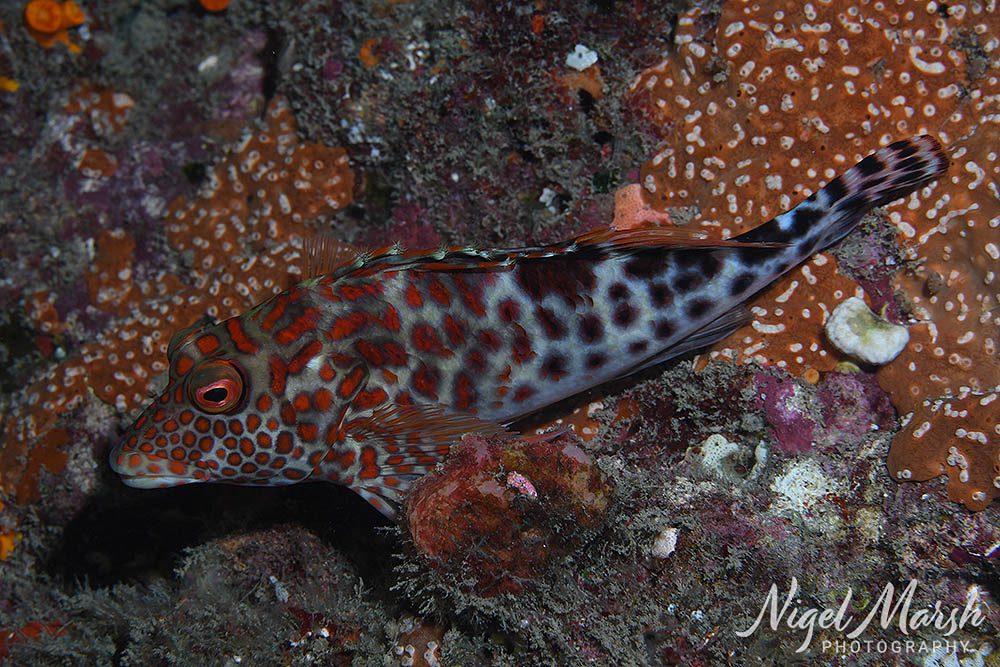
Positioned away from the mainland, Lord Howe Island has a unique mix of subtropical marine life, including a mix of species that are seen off the east coast of Australia, species seen off the northern end of New Zealand and also many of its own endemic species. I quickly spotted many unusual species, such as splendid hawkfish, Lord Howe butterflyfish, double-header wrasse, McCulloch’s anemonefish, Cooks scorpionfish and painted morwongs.

Unfortunately, just as we started to follow Aaron around the reef, we were hit by a massive surge which threw up a sandstorm and reduced the visibility. It was still a lovely dive, seeing a rocky reef covered in hard and soft corals, gorgonians, urchins, anemones and seastars. We also encountered a wonderful range of fishes, including damsels, sweetlips, lionfish, butterflyfish, wrasses, leatherjackets, drummer, pufferfish, boxfish and a Galapagos shark.
Conditions were a lot calmer at Malabar West, exploring a rocky reef with lots of ledges in depths from 10m to 16m. We saw many of the same fishes, while under the ledges were also schools of cardinalfish, bullseyes, soldierfish, lionfish, octopus and spiny lobsters.
The next day the swell and surge had almost disappeared as we explored two more sites around the Admiralty Islands. At Noddy Reef we cruised along a wall, seeing grey morays, kingfish, blue drummers and Galapagos sharks. However, the highlight for me was seeing two unique angelfish that are best seen at Lord Howe Island, the halfbanded angelfish and the conspicuous angelfish. While at Malabar Third Reef we explored ledges and caves to see morays, spiny lobsters, slipper lobsters, nudibranchs and a gathering of 25 black blotched stingrays.
Over the next few days, we explored more sites at this end of the island at Sugarloaf, Malabar Landslide and Roach Wall. By now the visibility was 30m, and at these sites we encountered more Galapagos sharks, schools of fusiliers and drummers and more of the rare angelfish.

We also had a lovely afternoon dive in the lagoon at Comet’s Hole, exploring coral garden in 7m of water that were overloaded with reef fish. While outside the lagoon we explored a fascinating series of rocky gutters at Octopus Garden. While no octopus, there were plenty of fish, including a rare endemic fish called the island longfin, a close cousin of the blue devil.
However, the diving highlight came on day three. With no wind and slight seas, we ventured 20km south to dive the spectacular Balls Pyramid. The remains of another volcano, this tower of rock rises 548m above the water line and is home to thousands of seabirds.

Our first dive at Observatory was stunning, with 45m visibility, lots of pelagic fish, Galapagos sharks and a massive cave to explore. Going no deeper than 26m, we first explored the cave, which is home to an incredible number of spiny lobsters and slipper lobsters. There were so many that they filled every crack and crevice in the cave. We next explored a gutter full of large boulders that were covered in pretty gorgonians and soft corals. Here we found groups of painted morwongs, soldierfish, striped boarfish, sweetlips, drummers, coral cods, wrasse and a good population of half banded angelfish.

For our next dive we headed several kilometres south to explore Sunken Rock. This rocky reef has bommies, gutters and ledges in depths from 36m to 12m. My goal on this dive was to photograph Australia’s most unique angelfish, the Ballina Angelfish, which is only found in shallow water at Balls Pyramid. It was another great dive, with pelagic fish, more Galapagos sharks and after a fair bit of searching we stumbled across two rare Ballina angelfish.
I had a wonderful week on Lord Howe Island. The island itself is stunning and the diving is spectacular, especially for someone like me – a huge fish nerd. The diving is best compared to the Solitary Islands, however with completely different fishes. Should you go, yes definitely if you can afford it. And if you can’t afford it, I would recommend saving your pennies and put it on your wish list.


