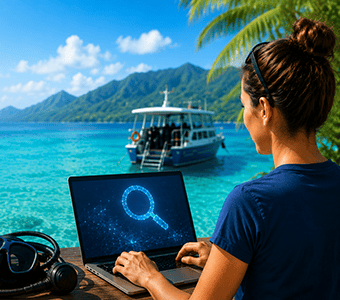
Every diver has a destination that changes the way they see the ocean. For many, that place is Palau. It was for me.

Known for its exhilarating drift dives, shark encounters, spectacular coral reefs and extraordinary marine biodiversity, Palau has long been considered one of the world’s greatest diving destinations. Last night I attended an event hosted by Travel Daily and Room-Res: Sustainable Tourism Spotlight: In Conversation with Palau. The conversation provided clarity that the country’s greatest achievement lies above the waterline. Palau isn’t simply protecting an extraordinary marine environment—it has built an entire tourism philosophy around protecting it.
The discussion featured Laura Clarke, Honorary Consul General of the Republic of Palau to Australia and co-founder of the internationally recognised Palau Pledge, alongside Honorina Fugawai, Tourism Manager at Pacific Trade Invest.
Conservation is culture
During the discussion, Clarke explained that conservation isn’t a modern concept in Palau.
“In Palauan culture, inheritance isn’t measured by wealth,” she said. “It’s measured by the health of the land and ocean you leave behind for the next generation.”
For divers, that philosophy is immediately obvious. Whether you’re hooked on at Blue Corner surrounded by reef sharks, watching mantas in German Channel, flying through Ulong Channel over beautiful coral gardens, or exploring the many WWII wrecks, the health of Palau’s marine ecosystems is unmistakable.
This isn’t accidental.
Palau became the world’s first shark sanctuary in 2009 and later established one of the largest marine sanctuaries on Earth. Today, 80 per cent of its Exclusive Economic Zone is protected from commercial fishing, creating a refuge for marine life on a remarkable scale.
Traditional conservation practices remain equally important. One example is bul, a customary closure of fishing grounds or ecosystems to allow nature to recover. These practices have guided resource management for generations and continue to influence modern marine conservation today.
The world’s first conservation pledge
Many travellers know about the Palau Pledge, but few appreciate just how revolutionary it was. Every visitor entering Palau signs an environmental pledge stamped into their passport, promising to protect the islands for future generations.
Unlike a list of regulations, the pledge was written from the perspective of Palauan children. Its message is simple: while you are here, treat this place as though it belongs to your own grandchildren.
The initiative has inspired similar visitor pledges around the world, but Palau remains the only country where signing the pledge forms part of the immigration process. For divers, it’s a reminder that every underwater interaction matters—from maintaining good buoyancy to respecting marine life and choosing reef-safe sunscreen.

A diver’s paradise—and much more
With more than 1500 fish species and around 700 coral species, Palau offers some of the richest marine biodiversity anywhere on Earth. Iconic dive sites including Blue Corner, Blue Holes, Peleliu Express, German Channel and Chandelier Cave regularly appear on lists of the world’s best dives.
Yet Palau offers far more than extraordinary diving.
Kayak through the UNESCO-listed Rock Islands. Float among 100s of stingless jellyfish at Jellyfish Lake. Cover yourself in mineral-rich white mud at the Milky Way lagoon. Explore WWII battlefields on Peleliu or discover traditional villages where culture remains a living part of everyday life. Increasingly, these cultural experiences are being developed in partnership with local communities, ensuring tourism supports Palau’s people as well as its environment.

Growing tourism without losing what matters
Around the world, over-tourism is becoming one of the industry’s biggest challenges.
Palau is taking a different path. Rather than chasing visitor numbers, the country is focused on attracting travellers who value conservation, culture and authentic experiences. As Clarke explained, a “high-value visitor” isn’t necessarily someone who spends the most money—it’s someone who understands the privilege of visiting such a special place.
That philosophy resonates strongly with divers. Responsible divers have always understood that healthy reefs, abundant marine life and respectful tourism are inseparable.

Why now is the perfect time to visit
Australian visitation is growing rapidly, supported by direct flights from Brisbane. For Australian divers, Palau has never been easier to reach. More importantly, it has never been more relevant.
As climate change, reef degradation and over-tourism reshape many dive destinations, Palau stands as proof that another model is possible—one where conservation isn’t a marketing slogan but a way of life. The country’s reefs remain among the healthiest on the planet because its people have chosen to protect them.
- As divers, we often say we want to leave nothing but bubbles.
- Palau asks us to leave something more.
- Respect.
- And perhaps a renewed understanding that every dive trip can become an act of conservation.